
What Is Acroyoga? A Practice in Trust, Told Through the Body
Acroyoga gets photographed a lot: Someone balanced on someone else's feet, mid-air, arms open. It's easy to see that image and file it under "cool trick." But the practice underneath the photo is about something else entirely: Trust, communication, and what happens in your body and your relationships when you practice both on purpose.
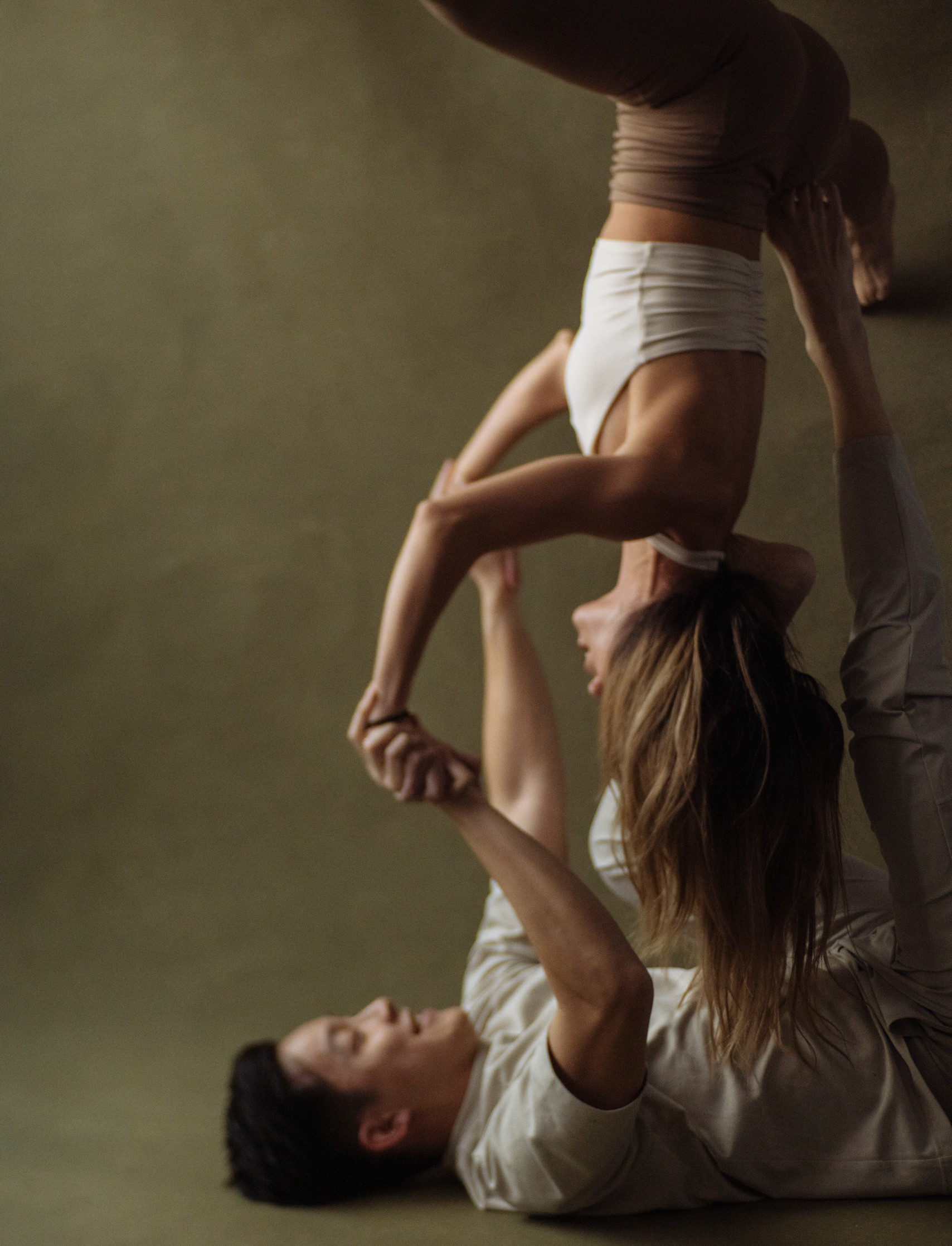
So, what actually is Acroyoga?
Acroyoga is a partner-based movement practice that blends yoga, partner acrobatics, and balance, built on trust, play, communication, and connection (AcroYoga International, n.d.). It was codified in the early 2000s by Jason Nemer and Jenny Sauer-Klein, who combined sports acrobatics, yogic postures, and Thai massage into a structured form of partner movement (AcroYoga International, n.d.).
Unlike Dance Movement Therapy, Acroyoga isn't a licensed psychotherapy; it's usually taught in fitness, recreational, or community settings. But practitioners consistently report social and emotional effects that go well beyond fitness (Raisio et al., 2024).
The structure is what makes it distinct. Practitioners move through three roles:
The base, grounded on the floor, providing physical support and stability. The flyer, balanced on the base, moving through shapes that require trust as much as flexibility. The spotter, positioned alongside, watching for safety and supporting the connection between base and flyer (AcroYoga International, n.d.).
Nobody stays in one role. Over a session, you might support someone else's full body weight, then be the one trusting someone else with yours, then step back and watch over both. That rotation is deliberate; it's a structured way to practice dependence and support, strength and vulnerability, leadership and following, all inside the same hour.
What does the research say it can do?
Acroyoga is very young in the research field - almost non-existent. That’s because it’s been traditionally seen as a leisure sport or a performative art. But as a practitioner myself, the somatic, body-mind, therapeutic potential through Acroyoga’s emphasis on respect and calibration can’t be missed. It has therapeutic potential - we just have to build the evidence for it.
However sparse, some accounts of its positive impact are starting to prevail. A qualitative study of Acroyoga practitioners found the theme of play running through almost every interview; participants described it as "letting out the inner child," a rare permission for adults to have unguarded fun, and something in being lifted that "may have last happened when you were a child" (Raisio et al., 2024, 2025). Practitioners also described developing a "shared rhythm" with their partners, a connection that went deeper than words, built through understanding someone else's timing and movement patterns.
That lines up with what we know about synchronized movement more broadly. Moving in coordination with another person is linked to affiliation, cooperation, trust, and shared affective experience (Manders et al., 2021; Reddish et al., 2013). One study found that synchronized movement (dancing specifically) raises pain threshold and strengthens social bonding independent of exertion alone (Tarr et al., 2015). Meta-analytic evidence shows synchrony reliably promotes prosocial behavior, group cohesion, and trust across contexts (Mogan et al., 2017; Tschacher et al., 2022). Acroyoga, structurally, is synchrony with stakes; you can't fake being in sync with someone when you're holding them off the ground.
There's a physical case too. Acroyoga demands sustained attention to breath, alignment, balance, proprioception, and interoception, much like conventional yoga, which has established links to improved physical function, strength, balance, flexibility, and broader psychological benefits including mindfulness and emotion regulation (Bennetts et al., 2022; Sivaramakrishnan et al., 2019). One study specifically measuring an Acroyoga-based exercise program found favorable effects on blood pressure in a group of young women (Struhár et al., 2019). But Acroyoga adds something yoga alone doesn't ask of you: Coordinating your body with someone else's in real time, communicating needs mid-movement, and negotiating safety together (Raisio et al., 2024).
What I've seen in my own work
Since 2024, I’ve been running an eight-week DMT-infused Acroyoga program with adolescent females in residential care. These girls were placed in out-of-home care for safety reasons. So it is clear that they’ve been through significant adverse childhood experiences. We’re hoping that our intervention could help improve the quality of their lives, support nervous system regulation, help them re-engage in supportive co-regulation and improve vitality and social skills.
In 2024, we managed to get consent from the children and the residence to conduct research for 2 specific runs. We measured quality of life before and after using the KIDSCREEN-10, and tracked session-by-session experience using the Dunphy Outcomes Framework.
The study revealed that participants’ self-rated quality of life had statistically improved over 8 weeks, coupled with psychosocial benefits like a sense of pleasure and capacity to cope with challenges. In the participants’ written reflections, the same themes kept surfacing without prompting: Trust, communication, courage, and a growing willingness to try again after a fall, literal and otherwise.
One participant, initially too afraid to fly, spent weeks writing about wanting to "open up... slowly but surely." By the final session, she'd become confident flying and wrote: "If you don't try, you never know. Don't hold back, be yourself." That's not something you can teach through a worksheet. It's something a body learns by being caught, again and again, until it believes it.
That's the case for Acroyoga, beyond the photos: A structured, physical practice in trust, for couples, for teams, for anyone who wants to build connection through the body instead of just talking about it.
If that's something you or your organisation wants to explore, or if you’re curious what this could look like for you, your team, or the young people you work with, reach out to me via email sqasity@gmail.com and follow our instagram page @movemendsg. I'm always glad to talk through what embodied approaches can offer in your context and tailor programmes to your needs.
References
AcroYoga International. (n.d.). Put your phone down, pick your friends up. https://www.acroyoga.org/
Bennetts, A. (2022). How does yoga practice and therapy yield psychological benefits? A review and model of transdiagnostic processes. Complementary Therapies in Clinical Practice, 46, 101514. https://doi.org/10.1016/j.ctcp.2021.101514
Manders, E., Goodill, S., Koch, S. C., Giarelli, E., Polansky, M., Fisher, K., & Fuchs, T. (2021). The mirroring dance: Synchrony and interaction quality of five adolescents and adults on the autism spectrum in dance/movement therapy. Frontiers in Psychology, 12, 717389. https://doi.org/10.3389/fpsyg.2021.717389
Mogan, R., Fischer, R., & Bulbulia, J. A. (2017). To be in synchrony or not? A meta-analysis of synchrony's effects on behavior, perception, cognition and affect. Journal of Experimental Social Psychology, 72, 13–20. https://doi.org/10.1016/j.jesp.2017.03.009
Raisio, H., Rask, M., Rantala, T., & Kuorikoski, T. (2024, 2025). Practicing Acroyoga in the space of possibilities: Complexity profile as a heuristic device in sport and exercise research. Journal of Sports Sciences, 43(1), 83–91. https://doi.org/10.1080/02640414.2024.2312482
Reddish, P., Fischer, R., & Bulbulia, J. (2013). Let's dance together: Synchrony, shared intentionality and cooperation. PLoS ONE, 8(8), e71182. https://doi.org/10.1371/journal.pone.0071182
Sivaramakrishnan, D., Fitzsimons, C., Kelly, P., Ludwig, K., Mutrie, N., Saunders, D. H., & Baker, G. (2019). The effects of yoga compared to active and inactive controls on physical function and health related quality of life in older adults — systematic review and meta-analysis of randomised controlled trials. International Journal of Behavioral Nutrition and Physical Activity, 16(1), 33. https://doi.org/10.1186/s12966-019-0789-2
Struhár, I., Vaculíková, P., Gimunová, M., Minster, D., & Körnerová, V. (2019). Effects of whole-body electrostimulation and acroyoga based exercise programme on blood pressure in a group of young women. Journal of Physical Education and Sport, 19(Suppl. 1), 49–57. https://doi.org/10.7752/jpes.2019.s1008
Tarr, B., Launay, J., & Dunbar, R. I. M. (2015). Synchrony and exertion during dance independently raise pain threshold and encourage social bonding. Biology Letters, 11(10), 20150767. https://doi.org/10.1098/rsbl.2015.0767
Tschacher, W., Rees, G. M., & Ramseyer, F. (2022). Interpersonal physiological synchrony predicts psychological sense of group cohesion. Frontiers in Human Neuroscience, 16, 903407. https://doi.org/10.3389/fnhum.2022.903407
Xing, Z. (2026). Effects of dance movement therapy and other dance-related interventions on depressive symptoms: A meta-analysis of evidence in the past decade. European Archives of Psychiatry and Clinical Neuroscience, 276(4), 1505–1519. https://doi.org/10.1007/s00406-026-02205-1
Ong Si Qi, S., Lebre, P., & Schoenenberger-Howie, S. (2026). Embodied support and relational challenge: A preliminary study of an Acroyoga-infused Dance Movement Therapy approach [Unpublished manuscript]. Move & Mend.
Comments